Big Five Spotting in Mikumi National Park
Big Five spotting in Mikumi National Park means four of the five, not all of them. Lion, elephant, buffalo and leopard are all present, while rhino were wiped out by poaching decades ago and have not been replaced. Elephant and buffalo are commonly seen, lion regularly, and leopard rarely. TANAPA has stated an intention to reintroduce black rhino from South Africa, though nothing has been confirmed as delivered. Mikumi covers 3,230 square kilometres in Tanzania’s Morogoro region.
Below is an honest species-by-species read on what a Big Five safari here can realistically produce.
Why Mikumi Has Four of the Big Five
The Big Five is a hunting term rather than an ecological one, describing the five animals considered most dangerous to hunt on foot: lion, leopard, elephant, buffalo and rhino.
Mikumi holds four. Rhino were lost to the poaching that decimated Tanzania’s population through the 1980s and into the 1990s, when national numbers fell from around 10,000 in the 1970s to 65 by the 1990s. The last rhino was recorded in Mikumi more than three decades ago.
Any itinerary or operator promising all five in Mikumi is either working from an out-of-date template or is not being straight with you. It is worth asking the question directly when booking, because the answer tells you something about who you are dealing with.
Four of five is still a strong showing for a park four hours from Dar es Salaam, and the park’s real distinction lies elsewhere anyway.
Do not build a Mikumi trip around a Big Five checklist. Leopard alone puts the full set out of reach here, and chasing it wastes hours better spent on the animals this park is genuinely good for, including eland, sable antelope and greater kudu.
Elephant Spotting on a Mikumi Big Five Safari
Elephant are among the most reliable of the four and the easiest to plan around.
They favour the isolated acacia and tamarind stands fringing the Mkata River, described as islands of shade, and spend the heat of the day there. Tamarind fruit will hold a group under a single tree for hours, and giraffe browse the same stands.
Water is the other reliable draw. Elephant come to drink mid-morning, roughly between nine and eleven, then throw mud across their backs before moving back into shade. The hippo pools and the Mkata and Chamgore waterholes are the places to be at that hour.
Numbers fluctuate because the population is not closed. Elephant and buffalo are recorded using Ukwiva Forest Reserve on the Rubeho massif west of the park, with researchers suggesting some animals move annually between those mountain forests and Mikumi.
Buffalo Spotting Across the Mkata Floodplain
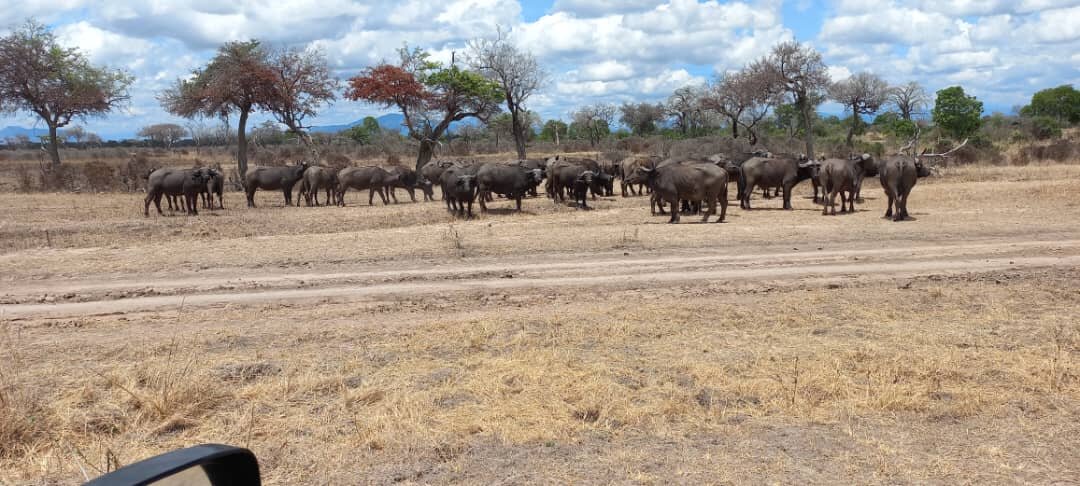
Buffalo are the species that most rewards a dry season visit and the easiest of the four to see in numbers.
As water becomes scarce between June and October, herds of up to several hundred gather at the remaining pools. They arrive in tight groups, drink quickly and move off, so catching a big herd is about being at water at the right moment rather than waiting all morning.
Old bulls separate from the main herd and are often alone or in small bachelor groups near cover. Guides give them room, since a lone bull is the least predictable large animal in the park.
Buffalo are also the animal most often killed on the highway crossing the park, with 135 recorded in the fifteen years from 1973, which says a good deal about how much they move across it.
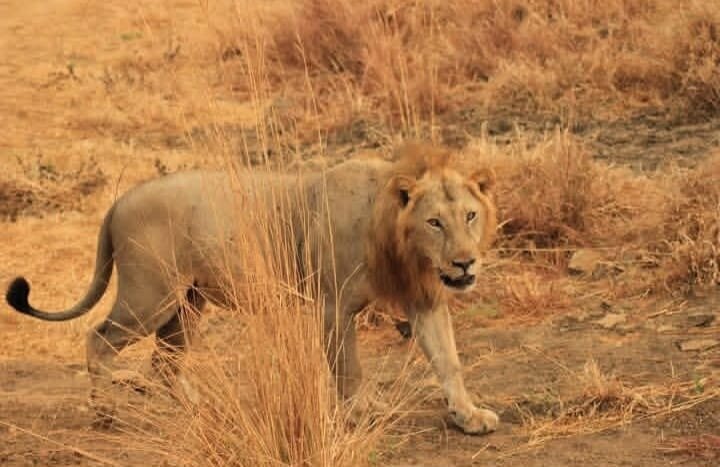
Lion Spotting on a Mikumi Big Five Safari
Lion sit at the boundary between reliable and uncertain, and this is where expectations most often go wrong.
Guides describe them as occasional rather than abundant. They are seen regularly on the Mkata Floodplain through the dry season, and Mikumi has a specific tell that works: lion here use the flattened tops of termite mounds as lookouts over the herds, since a mound gives roughly a metre of extra height over the grass.
Work the mounds with binoculars rather than sweeping the open ground. September and October give the best odds, when the grass is at its shortest and prey is concentrated at the last water.
During the rains, when grass grows past a metre, lion in Mikumi have been recorded resting in trees, which comes up often enough here to be worth asking about.
Over two mornings in October a sighting is a reasonable expectation. Over one afternoon in April it is not.
Four of the Big Five are present in Mikumi. Realistically you will see two of them well, one of them if you work for it, and the fourth almost certainly not at all.
Leopard Spotting and Why It Is Rare in Mikumi
Leopard are the weak link in any Mikumi Big Five attempt, and it is worth being blunt about it.
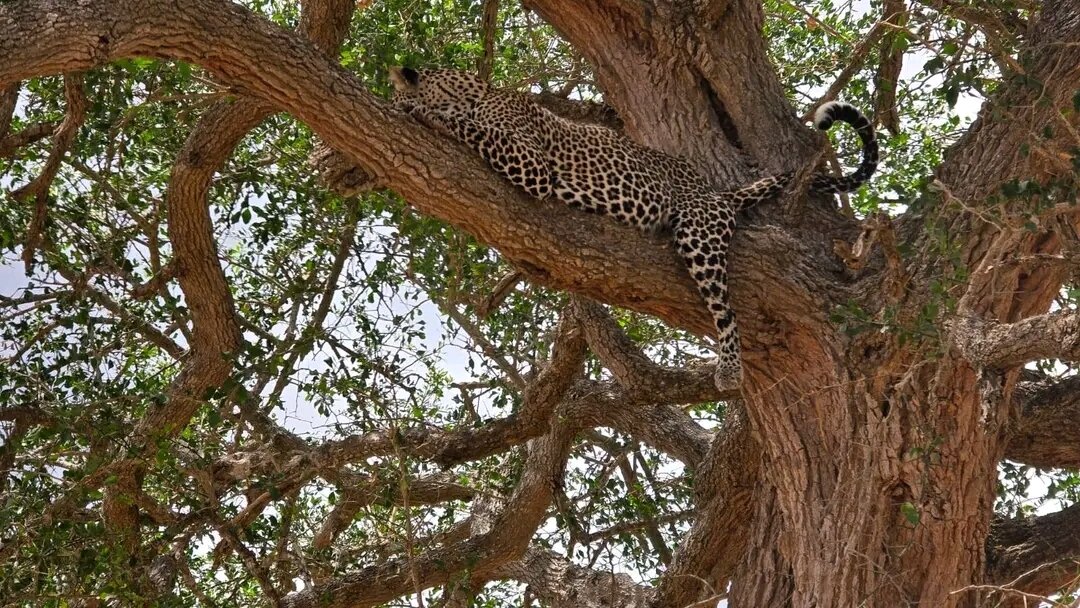
Wildlife guides rate them as rare here, sitting below lion. They are present and genuinely wild, but their behaviour makes them hard: solitary, secretive, hunting at night and lying up through the heat in dense cover.
Where to look is the riverine woodland along the Mkata River, where acacia and sausage trees give shade. Scan horizontally along branches rather than at the ground, looking for a hanging tail or an unnatural horizontal shape in a canopy of vertical lines.
The one realistic route is a night game drive. Mikumi is one of a short list of Tanzanian parks where they are permitted, running roughly eight until eleven with an armed ranger and a spotlight vehicle, at around US$50 per adult non-resident.
Baboon alarm calls are the other useful signal, since yellow baboons are present in numbers and shout when they see a leopard.
The Missing Rhino and Reintroduction Plans for Mikumi
Rhino are the reason Mikumi cannot offer a full Big Five, and the story is worth knowing.
Tanzania held around 10,000 rhino in the 1970s. Poaching cut that to 65 by the 1990s, recovering to 161 by 2018 and 190 by 2020. Mikumi lost its population in that collapse and the last animal was recorded more than three decades ago.
TANAPA has stated an intention to reintroduce black rhino, with animals available for relocation from South Africa and habitat surveys completed. Officials have described the plan as waiting on readiness rather than supply, and have noted that security would need strengthening afterwards. The precedent exists, since black rhino were flown from South Africa to the Serengeti in 2010 and again in 2019.
Nothing has been confirmed as delivered. Treat it as a stated intention rather than a schedule, and ask rangers at the park for the current position.
Best Time for Big Five Spotting in Mikumi
June to October is the dry season and the strongest window, with September and October the peak. Water is scarcest, animals concentrate on the remaining pools, and the grass is at its shortest, which matters most for lion.
From November to May the rains spread water across the whole plain, animals disperse and grass grows past a metre. Elephant and buffalo are still present but harder to locate, and lion become considerably more difficult.
March and April bring the heaviest rain and the poorest track conditions of the year.
June to October: best conditions for all four. Buffalo herds in the hundreds, elephant predictable at water mid-morning, lion visible on termite mounds. September and October are the peak.
November to February: green and dispersed. Elephant and buffalo present but scattered, lion harder in tall grass, with a better chance of finding them resting in trees.
March to May: hardest months. Tall grass, wet ground and some tracks impassable, with night drives sometimes suspended when conditions turn.
How Many Days for a Big Five Safari in Mikumi
Two nights giving three drives, with two of them at first light, is enough to make elephant, buffalo and a reasonable chance of lion realistic in the dry season.
Three nights with a night game drive added gives you the best structural chance at leopard that Mikumi offers, which is still a matter of luck rather than a plan.
No length of stay produces rhino, since they are absent from the park entirely.
If a complete Big Five is genuinely the goal, Mikumi is the wrong park. Nyerere National Park borders it to the south and can be reached in about two hours, and combining the two is the sensible arrangement for anyone set on the full list.
What Mikumi Offers Instead of a Full Big Five
The animals worth building a Mikumi trip around are not the famous five.
Common eland are the distinction. The Mkata Floodplain is widely rated the most reliable place in Tanzania to see the largest antelope in the world. Sable antelope and greater kudu hold to the miombo woodland toward the Vuma Hills, neither seen on open grass and neither accessible on the northern circuit.
Lichtenstein’s hartebeest works the woodland edge. Mikumi’s giraffe are considered transitional between the Masai and reticulated forms. Hundreds of hippo occupy the permanent pools, with a viewing area where you can leave the vehicle.
African wild dog range across the wider Selous ecosystem and pass through occasionally, making Mikumi one of the few East African parks where a sighting is possible at all.
Questions About Big Five Spotting in Mikumi
Does Mikumi have the Big Five?
Four of the five. Lion, elephant, buffalo and leopard are present, though leopard are rare. Rhino were wiped out by poaching decades ago and are currently absent. TANAPA has stated an intention to reintroduce black rhino from South Africa, but nothing has been confirmed as delivered.
What does a Big Five safari in Mikumi cost?
Park entry runs around US$30 per adult foreign non-resident per day and about US$10 for children aged 5 to 15, with a vehicle fee near US$40 per day for a six to twelve seat safari vehicle. Budget two day group trips from Dar es Salaam commonly run US$300 to US$500 per person. A night game drive, the best chance at leopard, costs around US$50 per adult non-resident.
How likely am I to see all four in Mikumi?
Elephant and buffalo are commonly seen in the dry season and lion are regular over two mornings. Leopard are rare enough that seeing all four on a short trip would be a good piece of luck. Realistically, plan for elephant, buffalo and a decent chance of lion.
Where can I see all of the Big Five near Mikumi?
Nyerere National Park, formerly the Selous Game Reserve, borders Mikumi to the south and is around two hours away. Combining the two is the usual arrangement for anyone set on a complete list, since Mikumi has no rhino at all.
What is the best month for Big Five spotting in Mikumi?
September or October, at the tail of the long dry season, when water is scarcest, herds gather at the remaining pools and the grass is short enough to pick lion off termite mounds. The wider dry season from June to October all works well.
Will rhino be brought back to Mikumi?
TANAPA has stated the intention, with animals available from South Africa and habitat surveys completed, and officials have described the plan as waiting on readiness. Black rhino were flown from South Africa to the Serengeti in 2010 and 2019, so the precedent exists. Nothing has been confirmed as delivered, so ask rangers at the park for the current position.
Booking Your Mikumi Trip
The safari companies and tour operators listed on this website put trips like this together for a living and know which camps, guides and routes actually deliver. We are an independent guide to Mikumi; we do not book or sell tours ourselves.
When you are ready, arrange your safari, tour or holiday with one of the recognised operators listed here. Tell them your dates and what matters most, and a real person, not a form, will handle the itinerary, park bookings and logistics for you.